Standing Orders
Use a Standing Order to create a single order in ARM, which automatically generates recurring orders based on a configured schedule. See Standing Orders.
Permissions
Users require the Can Raise Standing Orders permission in order to view and raise Standing Orders.
Users with the View Standing Orders permission can view Standing Orders in their assigned locations.
Users with the Edit Standing Orders permission can edit Standing Orders in their assigned locations.
-
To create a new Standing Order, see New Standing Order.
-
To work with existing Standing Orders:
-
Select
 Standing Orders on the Side Menu. See Side Menu.
The Standing Orders page opens.
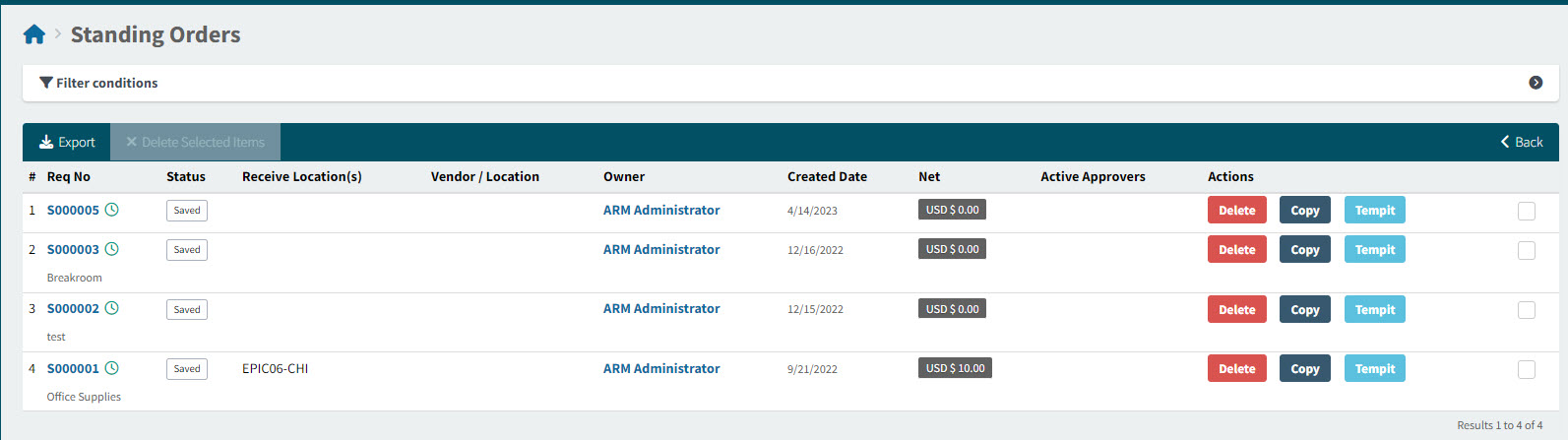
Req No The unique requisition number for this document. Click on the Req No to open the Requisition.
Status The document status. This could be:
-
Saved
-
Submitted
-
Rejected
-
Approval in Progress
-
Approved
-
Ordered
-
Received
-
Pending Review
-
Pending Revision
-
Standing Order Active
-
Standing Order Completed
-
Standing Order Cancelled
Receive Location(s) The receiving location on the document header. If there is more than one Location, you can click on the ellipsis (…) button to view all Locations in a pop-up box.
Vendor/Location The list of Vendor Codes and Supply Location Codes for the lines in this document. If the list has more than two Vendors/Supply Locations, an ellipsis (…) button appears. Click on the ellipsis to see the full list in a pop-up box.
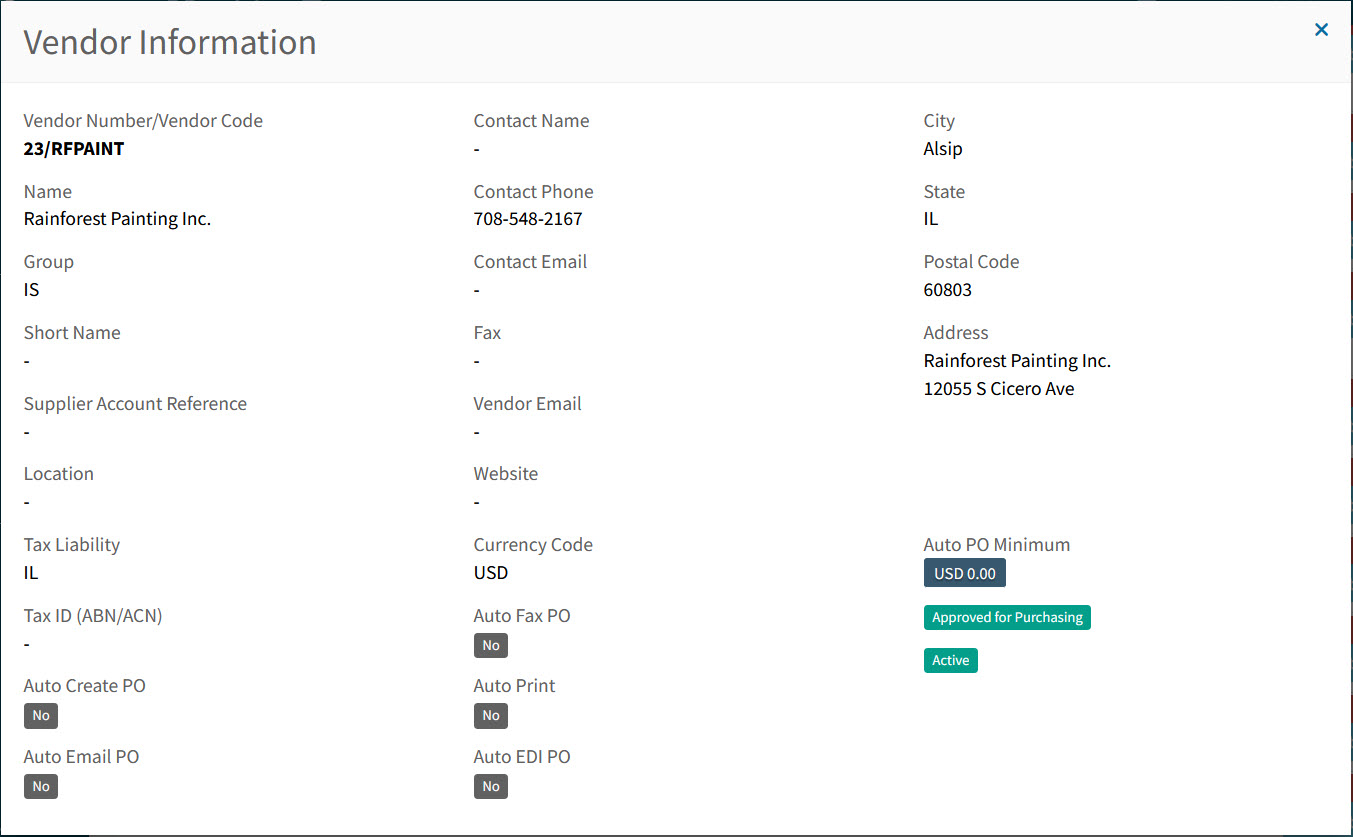
Vendor Codes are in blue. Hover over a Vendor Code to view the full Vendor Name, or click on a Vendor Code to open the details in the Vendor Information pop-up screen.
Example
Owner The document owner. This is the User who created the document.
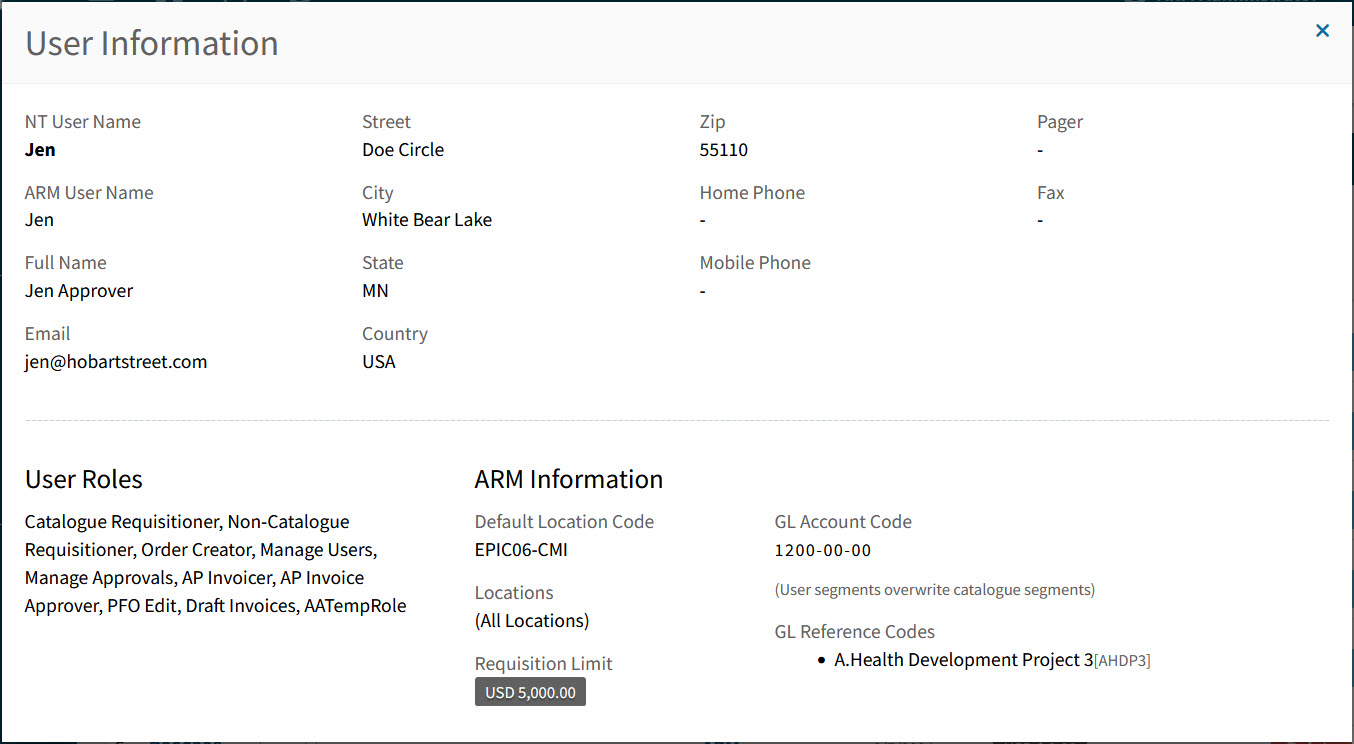
Owner Names are in blue. Hover over an Owner Name to view the full Name, or click on an Owner Name to open the details in the User Information pop-up screen.
Example
Created Date The date the document was created.
Net This label shows the net value (sum of all lines), excluding tax. The currency is included.
Active Approvers The Approver(s) at the current step in the approval workflow. An Active Approver can approve or reject a requisition.
Actions Standing Order actions:
Available options under the Actions column depend on your User permissions.
- Delete
-
Click Delete to delete the standing order on this row. On the confirmation dialog pop-up, click Yes to confirm. (Requires Permission: Quick Delete.)
- Copy
-
Click Copy to copy the template on this row. Select from the Requisition Copy Options, then click Save & Close. (Requires Permission: Can Copy Req and Template.)
See Requisition Copy Options
- Header Only
-
Only copy the header information, such as dates and payment type.
- Include Attachments
-
Include any attachments in the copy.
- Include Notes
-
Include any notes in the copy.
- Include Custom Data
-
Include any custom data in the copy. This option is only available if the Use Requisition Types Global Setting is set to Yes.
- Include Recurring Setting
-
Include the Recurrence Settings (Recurrence Pattern and Range Of Recurrence) in the copy.
- Copy Tax Data
-
For each line, copy the Tax Liability and Tax Category.
- Fast Copy
-
Copy all details of each line. Without this option selected, the default values (not the edited values) for each line are used.
- Copy Line Date Fields
-
For each line, copy the dates.
- Requester
-
This is the default Requester on the new document. Either keep the Requester (which is the Requester linked to you, the logged-in user), or select a different Requester, from the list of Requesters that you can request for.
- Tempit
-
Click Tempit to create a template from this row. Select from the Requisition to Template Options, then click Save & Close. (Requires Permission: Can Convert to Template.)
See Requisition to Template Options
- Header Only
-
Only copy the header information, such as dates and payment type.
- Include Attachments
-
Include any attachments in the copy.
- Include Notes
-
Include any notes in the copy.
- Include Custom Data
-
Include any custom data in the copy. This option is only available if the Use Requisition Types Global Setting is set to Yes.
- Include Recurring Setting
-
Include the Recurrence Settings (Recurrence Pattern and Range Of Recurrence) in the copy.
- Copy Tax Data
-
For each line, copy the Tax Liability and Tax Category.
- Fast Copy
-
Copy all details of each line. Without this option selected, the default values (not the edited values) for each line are used.
- Copy Line Date Fields
-
For each line, copy the dates.
- Requester
-
This is the default Requester on the new document. Either keep the Requester (which is the Requester linked to you, the logged-in user), or select a different Requester, from the list of Requesters that you can request for.
- Select check box
-
Select the check box next to one or more standing order rows, then click Delete Selected Items on the menu bar, to delete the selected templates. (Requires Permission: Quick Delete.)
-
-
Adjust the filter conditions.
See Details
-
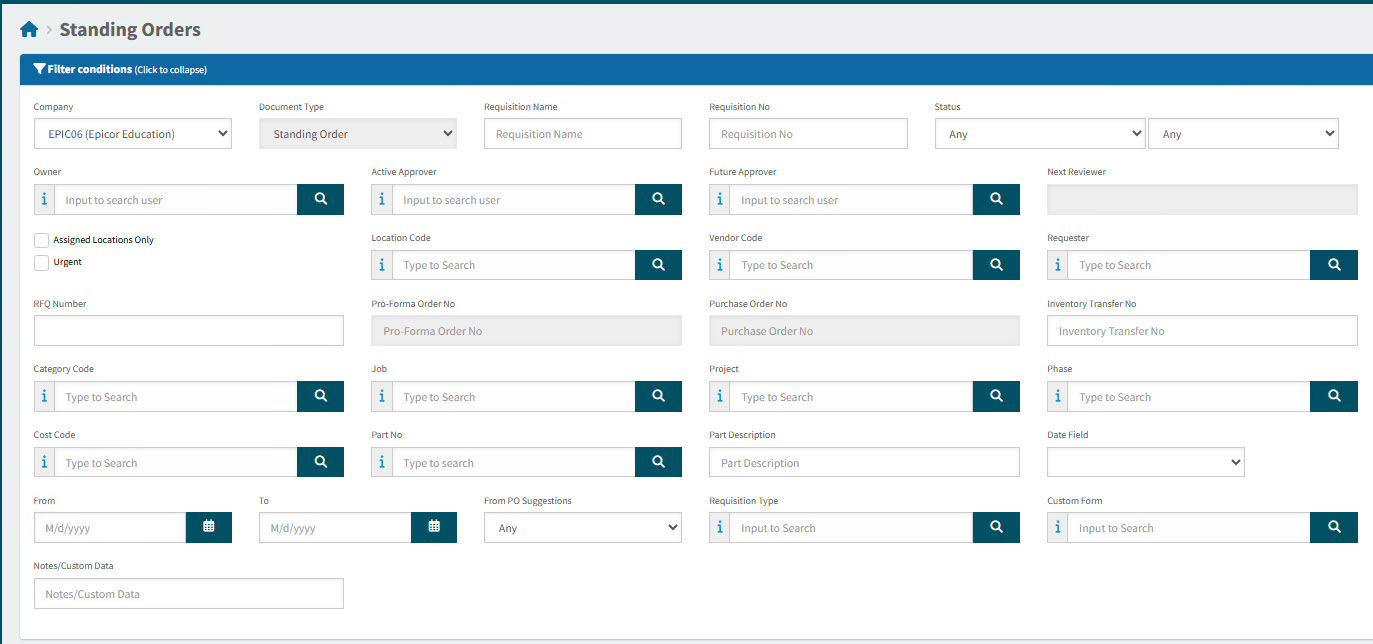
Expand the filter conditions in the top section of the page to search for a specific Standing Order or to narrow your search.
View filter conditions
-
Enter values in the edit boxes, or select from the search boxes. See the filter conditions, below.
Filter conditions
Company Select a Company.
Requisition Type This field is locked to 'Standing Order'.
Requisition Name Enter a name or partial name followed by the % character to list all Standing Orders with a name that contains those characters.
Requisition No Type in the Standing Order Number if known, or do a partial search using part of the number followed by %. For example, S0001% will return all Standing Orders starting with S0001.
Status Select one of the following status values from the drop-down list:
-
Any
-
Saved
-
Submitted
-
Rejected
-
Approval in Progress
-
Approved
-
Ordered
-
Received
-
Pending Review
-
Pending Revision
-
Standing Order Active
-
Standing Order Completed
-
Standing Order Cancelled
Further refine the list by selecting Any, Not Suspended or Suspended from the adjacent drop-down list.
Owner Type in the User Name, or partial with the % sign, of the person that created the Standing Order, and click on a name from the displayed list.
Active Approver Select a user from the drop-down list. Filters for this user as an active approver for the requisition.
Future Approver Select a user from the drop-down list. Filters for this user as a future approver for the requisition.
Next Reviewer This field is disabled.
Assigned Locations Only If this check box is selected only documents for Locations assigned to the User in their User Profile will be displayed.
Location Code Select a Location Code to filter from.
Vendor Code Select a Vendor Code.
RFQ Number Type in the Request For Quote No if known, or do a partial search using part of the number followed by %.
Pro-Forma Order No The number of the pro-forma order originating from this requisition.
Purchase Order No The number of the purchase order originating from this requisition.
Inventory Transfer No Type in the Transfer Order No if known, or do a partial search using part of the number followed by %.
Category Code Select a Category Code and any Standing Order with a line that matches the value will be returned.
Job Select a Job Code and any Standing Order with a line that matches the value will be returned.
Project Select a Project Code and any Standing Order with a line that matches the value will be returned.
Phase Select a Phase (dependent on the value selected in the Project field).
Cost Code This is an independent field and can be selected against any Project when ARM is configured for use with Advanced Projects Management (APM).
Part No Type in a Part No, or click the field search icon
 to select a Part Number from the Search Catalogue page.
Part Description Type in the Part Description if known, or do a partial search using part of the description followed by %.
Date Field Select one of the following date values from the drop-down list:
-
Date Created
-
Date Modified
-
Date Submitted
-
Date Approved
Enter a date range, or just a From Date, or just a To Date.
From PO Suggestions Choose Any, Yes, or No.
Custom Form Select any of the Custom Forms if the ARM system is configured to use these.
Notes/Custom Data You can type in a whole or partial string to search values present within:
-
Internal and External note fields
-
Line note fields
-
Custom UDF value fields
-
-
Standing Orders that match the search conditions are listed in the grid.
-
Standing Order Workflow
-
Step 1: Create a Standing Order, giving it a schedule.
-
Step 2: Submit it for Approval.
-
Step 3: The Standing Order is approved, using the same approval workflow as a standard requisition.
-
Step 4: An associated job is generated. This can be viewed on the Scheduled Jobs page. See Standing Order Scheduled Jobs.
The job controls and logs the automation of child requisitions, based on the Standing Order’s schedule.
| If the Standing Order Reminder scheduled job is enabled, a notification is sent to the Owner of the Standing Order before it is due to end. |
Standing Order Status
A Standing Order has a slightly different set of statuses compared with a Standard Requisition.
-
After a Standing Order is approved, it will go to an 'Approved' status like a standard requisition.
-
After the first recurrence, the status updates to 'Standing Order Active'. The status remains 'Standing Order Active' until either:
-
After the final recurrence, the status changes to 'Standing Order Completed'.
OR
-
If it is cancelled, the status changes to 'Standing Order Cancelled'.
-
Standing Order Recurrence
You need to set up a recurrence schedule before you can submit a standing order.
This is described in the section Setting a Schedule.
| A Standing Order does not have its own PFO and PO documents. Its child requisitions, generated by the scheduled job for the Standing Order, have their own PFOs and POs, as with standard requisitions. |
Scheduled Jobs
- Standing Orders
-
You can Enable/Disable a Standing Order scheduled job during its operating timeline. You can also manually generate a child requisition.
- Standing Order Auto Pricing Updates Check
-
This job monitors the Standing Orders with Maintain Current Pricing selected.
- Standing Order Reminder for nearing end date
-
This job monitors any active Standing Orders and sends an email alert to the original requisitioner when a recurring schedule is nearing its configured timeline.
Once the final requisition recurrence has occurred, the Standing Order moves to a ‘Standing Order Completed’ status.
| A Standing Order can be cancelled at any time after it has been submitted. |
Maintain Current Pricing
The Maintain Current Pricing check box is on the document header.
If this is selected:
-
Any catalogue line items are regularly assessed against the catalogue. This is controlled by the Scheduled Job: Standing Order Auto Pricing Updates Check.
-
If the price of an item increases:
-
The affected line reverts to Requiring Approval.
-
No subsequent requisitions are generated until the Standing Order status returns to Approved.
-
-
If the price of an item decreases:
-
The Standing Order status remains Approved.
-
Subsequent requisitions use the updated line value.
-
Standing Order Functionality
-
Create a standing order. See Creating a Standing Order.
-
Submit a standing order. See Submitting a Standing Order.
-
Revise a standing order. See Revising a Standing Order.
-
Copy a standing order. See Copying a Standing Order.
-
See how to view and edit a standing order. See Viewing and Editing a Standing Order.
-
Cancelling a standing order. See Cancelling a Standing Order.
-
Deleting a standing order. See Deleting a Standing Order.
See how to search for a standing order. See Searching for a Standing Order.
Submitting a Standing Order
When all required items have been added to a standing order, it can be submitted for approval.
-
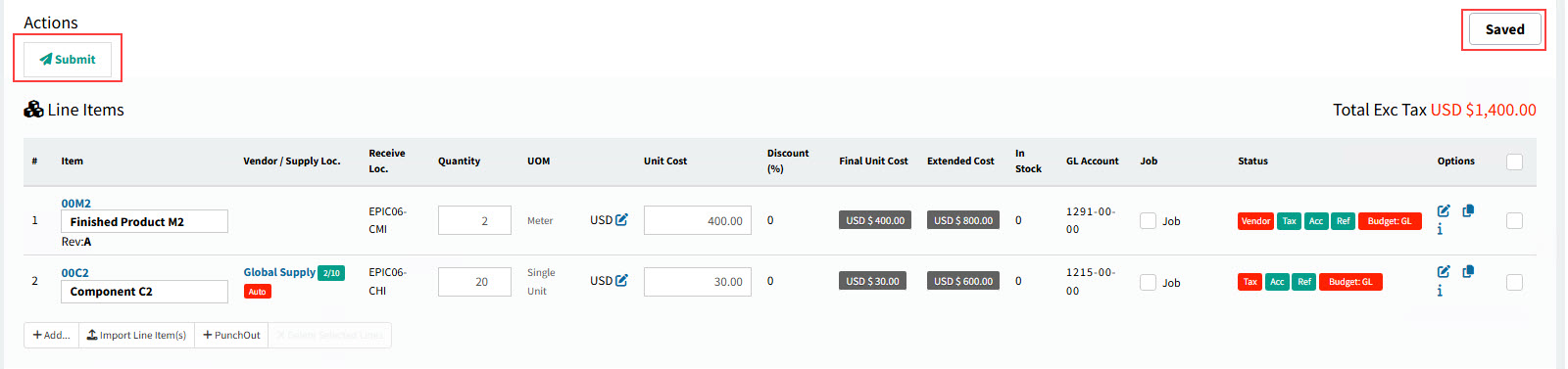
Click Submit in the Actions section.
|
Revising a Standing Order
You can revise an approved standing order at any time.
-
If line values increase, the standing order needs to go through the approval process again.
-
While the standing order is not in the Approved status, no child Requisitions are generated.
-
The generation of child Requisitions resumes after the standing order is in the Approved status.
-
-
If the value of lines decreases or lines are removed, the standing order will remain in the Approved state, and the generation of child Requisitions continues, based on the updated lines.
The Total Remaining and Total Final Value totals are updated to reflect the new values.
To revise a standing order:
-
Select
Standing Orders on the Side Menu. See Side Menu. -
Set the filter conditions to search for the standing order.
-
Select the Req No to open Requisitions > [Standing Order No.].
-
Select Revise from the Workflow menu in the Actions section.
The status updates to Pending Revision.
Copying a Standing Order
In order to copy a standing order you must be a requisition creator, or an approver in the approval flow, or a user with Administrator permission (provided you have the standing order’s location in your allowed locations list).
Copy a Standing Order
-
Select
Standing Orders on the Side Menu. See Side Menu. -
Set the filter conditions to search for the standing order you want to copy.
-
Either click Copy on the standing order in the results grid or select the Req No to open Requisitions > [Standing Order No.] and click
 Copy on the top menu bar.
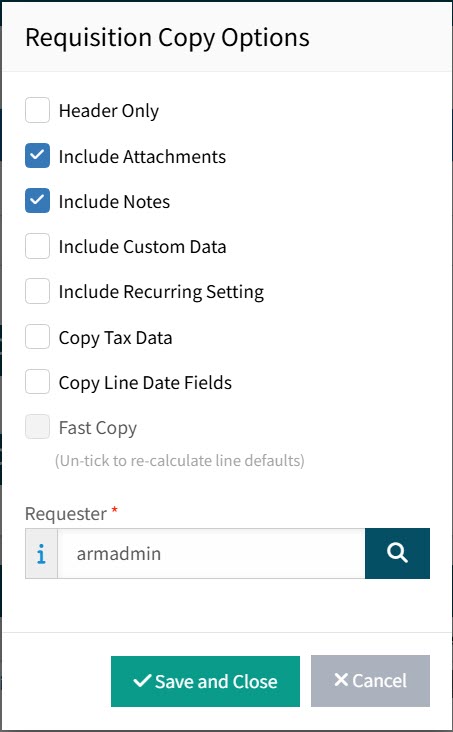
The Requisition Copy Options dialog displays.
-
In Requisition Copy Options:
-
Select from the available options from the Requisition Copy Options dialog:
- Header Only
-
Only copy the header information, such as dates and payment type.
- Include Attachments
-
Include any attachments in the copy.
- Include Notes
-
Include any notes in the copy.
- Include Custom Data
-
Include any custom data in the copy. This option is only available if the Use Requisition Types Global Setting is set to Yes.
- Include Recurring Setting
-
Include the Recurrence Settings (Recurrence Pattern and Range Of Recurrence) in the copy.
- Copy Tax Data
-
For each line, copy the Tax Liability and Tax Category.
- Fast Copy
-
Copy all details of each line. Without this option selected, the default values (not the edited values) for each line are used.
- Copy Line Date Fields
-
For each line, copy the dates.
- Requester
-
This is the default Requester on the new document. Either keep the Requester (which is the Requester linked to you, the logged-in user), or select a different Requester, from the list of Requesters that you can request for.
-
Click OK.
The default state of each copy option can be controlled via Global Settings, in the Requisition Copy Options group. See Global Settings. A new standing order document is created and displayed in Requisitions > Saved > [Standing Order No.]
Quantities are only copied from the original standing order if the Copy Requisition & Template Quantities option for the Defaults Group is set to Yes on the Setting Maintenance page, or if you tick the Fast Copy check box on the Copy Options dialog. Otherwise, the quantities for the new standing order are set to zero. -
-
On the standing order detail page modify the document as required. See Creating a Standing Order.
-
Click OK to save the standing order.
Searching for a Standing Order
-
To create a new Standing Order, see New Standing Order.
-
To work with existing Standing Orders:
-
Select
Standing Orders on the Side Menu. See Side Menu.The Standing Orders page opens.
-
Adjust the filter conditions.
See Details
-
Expand the filter conditions in the top section of the page to search for a specific Standing Order or to narrow your search.
View filter conditions
-
Enter values in the edit boxes, or select from the search boxes. See the filter conditions, below.
Filter conditions
Company Select a Company.
Requisition Type This field is locked to 'Standing Order'.
Requisition Name Enter a name or partial name followed by the % character to list all Standing Orders with a name that contains those characters.
Requisition No Type in the Standing Order Number if known, or do a partial search using part of the number followed by %. For example, S0001% will return all Standing Orders starting with S0001.
Status Select one of the following status values from the drop-down list:
-
Any
-
Saved
-
Submitted
-
Rejected
-
Approval in Progress
-
Approved
-
Ordered
-
Received
-
Pending Review
-
Pending Revision
-
Standing Order Active
-
Standing Order Completed
-
Standing Order Cancelled
Further refine the list by selecting Any, Not Suspended or Suspended from the adjacent drop-down list.
Owner Type in the User Name, or partial with the % sign, of the person that created the Standing Order, and click on a name from the displayed list.
Active Approver Select a user from the drop-down list. Filters for this user as an active approver for the requisition.
Future Approver Select a user from the drop-down list. Filters for this user as a future approver for the requisition.
Next Reviewer This field is disabled.
Assigned Locations Only If this check box is selected only documents for Locations assigned to the User in their User Profile will be displayed.
Location Code Select a Location Code to filter from.
Vendor Code Select a Vendor Code.
RFQ Number Type in the Request For Quote No if known, or do a partial search using part of the number followed by %.
Pro-Forma Order No The number of the pro-forma order originating from this requisition.
Purchase Order No The number of the purchase order originating from this requisition.
Inventory Transfer No Type in the Transfer Order No if known, or do a partial search using part of the number followed by %.
Category Code Select a Category Code and any Standing Order with a line that matches the value will be returned.
Job Select a Job Code and any Standing Order with a line that matches the value will be returned.
Project Select a Project Code and any Standing Order with a line that matches the value will be returned.
Phase Select a Phase (dependent on the value selected in the Project field).
Cost Code This is an independent field and can be selected against any Project when ARM is configured for use with Advanced Projects Management (APM).
Part No Type in a Part No, or click the field search icon
to select a Part Number from the Search Catalogue page.Part Description Type in the Part Description if known, or do a partial search using part of the description followed by %.
Date Field Select one of the following date values from the drop-down list:
-
Date Created
-
Date Modified
-
Date Submitted
-
Date Approved
Enter a date range, or just a From Date, or just a To Date.
From PO Suggestions Choose Any, Yes, or No.
Custom Form Select any of the Custom Forms if the ARM system is configured to use these.
Notes/Custom Data You can type in a whole or partial string to search values present within:
-
Internal and External note fields
-
Line note fields
-
Custom UDF value fields
-
-
Standing Orders that match the search conditions are listed in the grid.
-
The standing orders are listed here by Receive Location then by most recently created date.
Viewing and Editing a Standing Order
To edit a standing order, you need to be the standing order creator or an Administrator.
Editing a Standing Order
-
Locate the standing order you want to view or edit. See Searching for a Standing Order.
-
Click the Req No link on the Standing Orders page, to open the standing order.
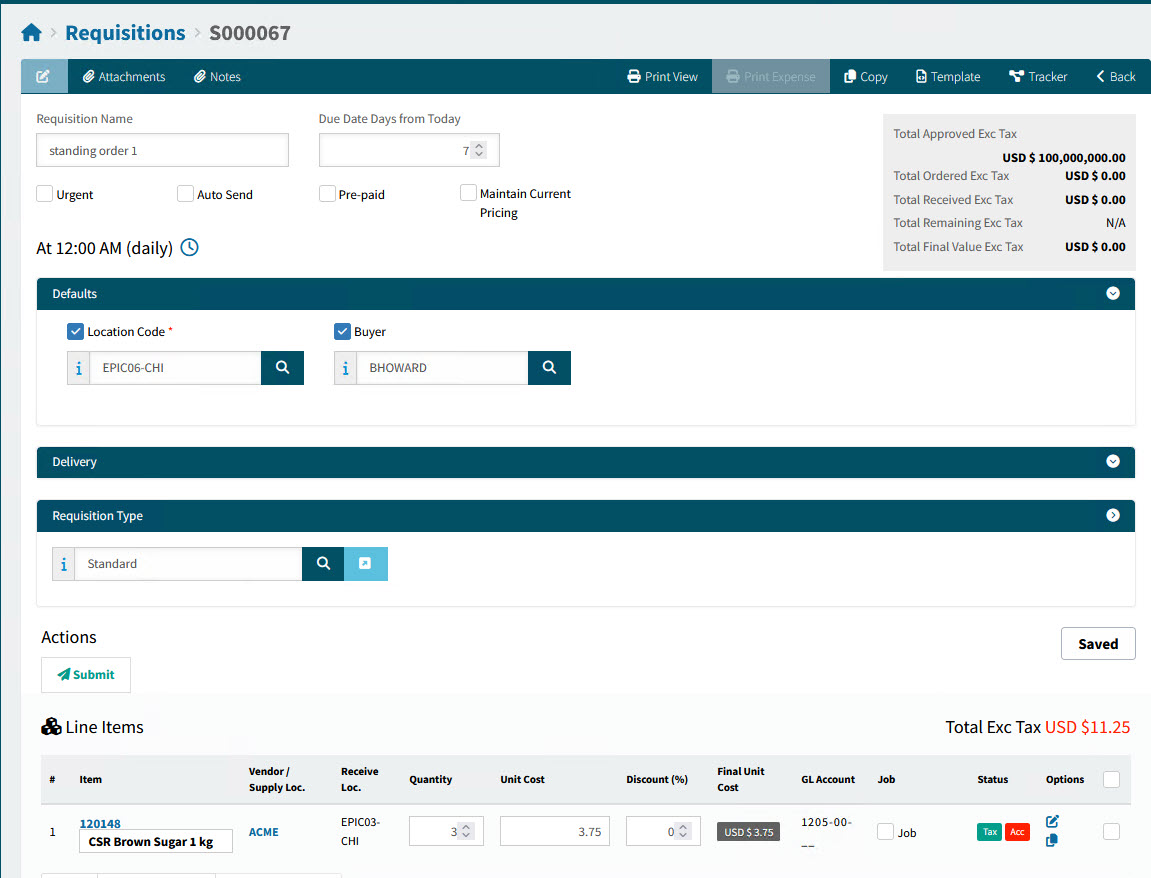
The Requisitions > [Standing Order Number] page opens:
-
On the Requisitions > [Standing Order Number] page, edit the Line Item details as required:
You can:
-
Edit the Item description.
-
Update the Quantity.
-
Update the Unit Cost.
-
Update the Discount %.
-
Enter Job details.
Purchase for an item a job (details are sourced from Kinetic). You can select a job, assembly and material/operation.
View Standing Order Line Items

-
-
To make further changes to the standing order, refer to the instructions in Creating a Standing Order.
See how to:
-
Update the standing order Header.
-
Add standing order Line Items.
-
Edit standing order Line Items.
-
Apply new defaults to selected Line Items.
-
Delete standing order Line Items.
-
Update the Requisition Type Section.
-
-
Click Save to save the changes to the standing order.
Standing Order Header Menu
On the Header Menu Bar you can perform additional functions:
Header Menu Bar

 Attachments
-
Use this function to upload files. See Adding Attachments to Header.
The Global Setting Attachment Upload File Filter stores the file types that can be uploaded as Attachments.
The attachments are added to each child requisition generated from the standing order.
- Notes
-
Use this function if you want to add multiple Internal notes, or a single External note. Notes can be deleted if you have the permission Can Delete Own Internal Notes or Can Delete Any Internal Note. See Adding Notes.
The notes are included in child requisitions generated from the standing order.
 Print View
-
Downloads a copy of the document that can be printed off. Only enabled once the document has one or more lines.
- Print Expense
-
Use this to download a copy of the Expense Docket. This is enabled if the document has an Expense line item.
 Copy
Copy-
Click this button to copy this document.
 Template
-
Click the Template button to create a template from this document.
 Tracker
-
Click to view the Tracker for this document. Read more about Trackers.
 Back
Back-
Click Back to return to the search page.
Standing Order Footer Menu
Footer Menu

The options here depend on the document status. For example, a Requisition with the Approved status does not have a Delete button.
| Save & Close |
Save the current changes and return to the previous page. |
| Save |
Click this button to apply the changes and keep the form open. |
| Refresh |
Click this button to refresh unsaved data. |
| Delete |
Delete the document. |
Cancelling a Standing Order
A Standing Order can be cancelled at any time once it has been submitted.
-
Select
Standing Orders on the Side Menu. See Side Menu. -
Set the filter conditions to search for the standing order.
-
Select the Req No to open Requisitions > [Standing Order No.].
-
Select Cancel from the Workflow menu in the Actions section.
-
Enter a Reason on the Cancel Standing Order pop-up form, then click Save.
An email is generated and sent to the original requisitioner with the details of the standing order and a copy of the canceled reason for reference.
Deleting a Standing Order
A standing order can be deleted by the standing order creator or an Administrator. It must have the Saved status.
Delete a Saved Standing Order
-
Select
Standing Orders on the Side Menu. See Side Menu.Alternatively, you can locate the standing order under Requisitions > Saved.
-
Set the filter conditions to search for the standing order you want to delete.
-
Either click Delete on the standing order in the results grid or select the Req No to open Requisitions > [Standing Order No.] and click Delete on the footer menu bar.