Requester Groups
Use Requester Groups to share default settings, such as a Default Company and Default Location Code, amongst a Group of Requesters. A Requester can only belong to one Requester Group.
Permissions
Maintain Requester Groups is an Administration function. Users with this permission can create, edit, delete, activate and deactivate Requester Groups.
- Requesters
-
Requesters may or may not be ARM Users. If a Requester is not a User, an Authorized User for their Requester Group may raise Requisitions on their behalf.
Maintaining Requester Groups
-
Select the Requester Groups menu item on the Administration Page. See Administration Page.
A list of Requester Groups matching the search criteria is displayed.
View Requester Groups
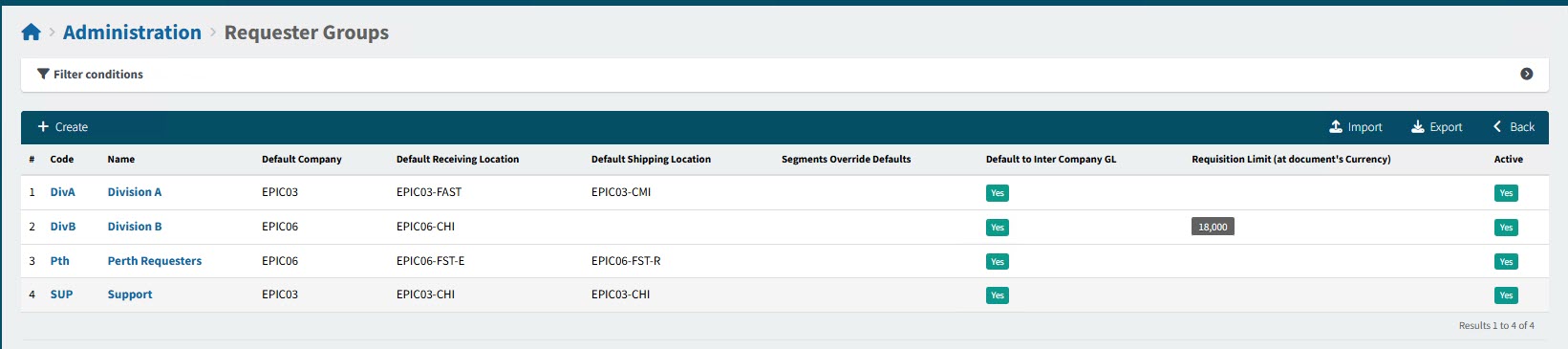
Code Click on the Requester Code to open the requester details.
Name Click on the Requester Name to open the requester details.
Group The requester group that this requester belongs to.
Default Company The requester’s default company.
Default Receiving Location The requester’s default receiving location.
Default Shipping Location The requester’s default shipping location.
Segments Override Defaults The requester’s Segments Override Defaults (Yes or No).
Default to Inter Company GL Defines whether the Default to Inter Company GL rule applies to the requester.
Requisition Limit (at document’s Currency) The requester’s Requisition Limit.
Active Indicates whether this is an Active requester (Yes or No).
Link User This is the user linked to the requester. Not every Requester has a linked user. Click on the Link User name to open the Administration > Users > User Detail page for that user.
-
Maintain Requester Groups:
-
To create a new Requester Group, see Creating a Requester Group.
-
To edit a Requester Group, see Editing a Requester Group.
-
To delete a Requester Group, see Deleting a Requester Group.
-
Creating a Requester Group
On the Administration > Requester Groups page:
-
Click the
 Create button on the Menu Bar.
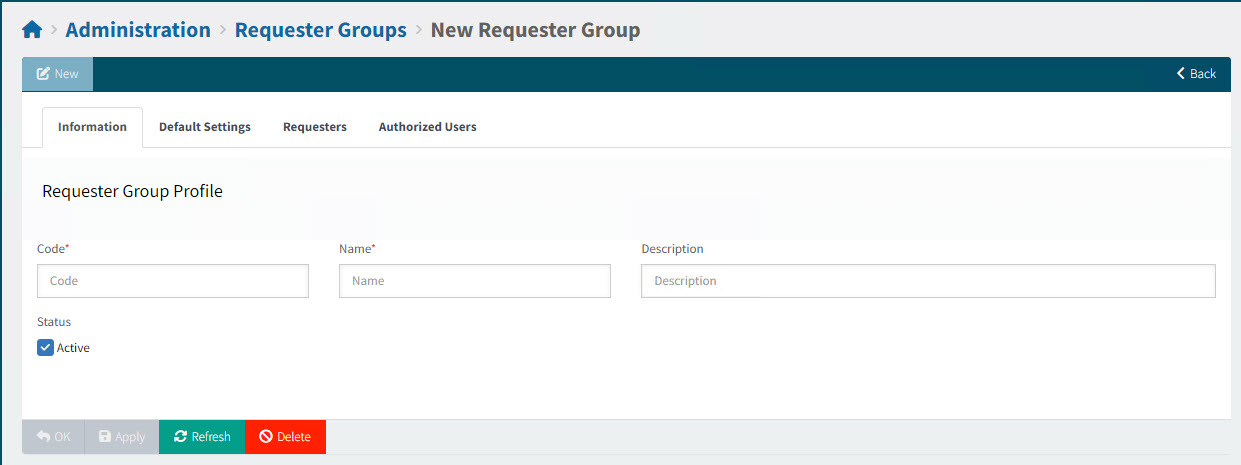
The Requester Groups > New Requester Group page is displayed.
-
Enter a Requester Group Profile.
-
Enter a unique Code.
-
Enter a Name.
-
Enter a Description.
-
Ensure the Active check box is selected.
-
-
Select Apply to save the new Requester Group.
-
Update the details on the separate tabs for the new Requester Groups. Follow the instructions in Editing a Requester Group.
Editing a Requester Group
-
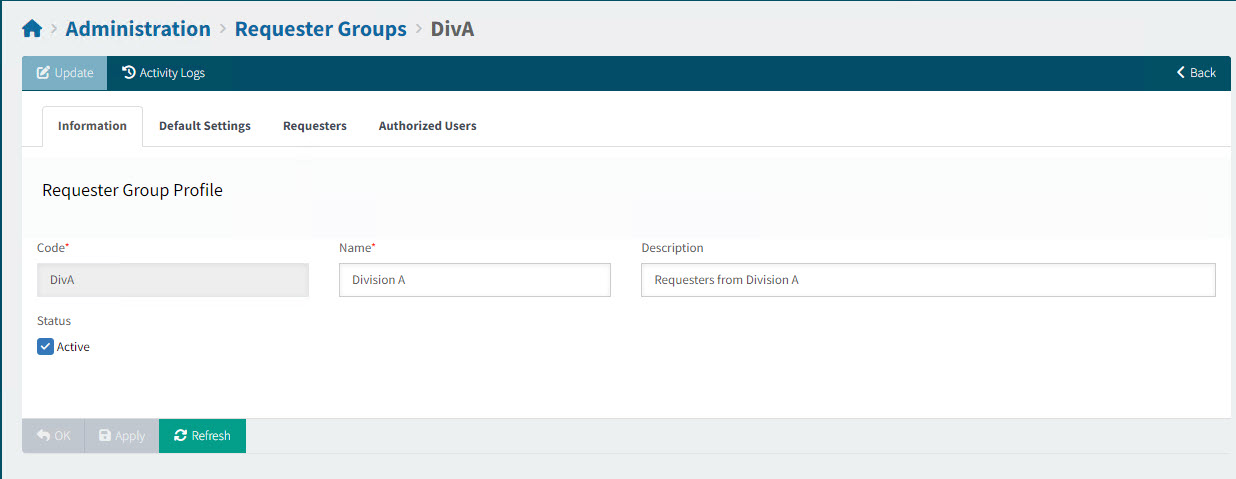
Select a Code or Name to open the Administration > Requester Groups > [Requester Group Code] page.
The page has four tabs:
-
Information
-
Default Settings
-
Requesters
-
Authorized Users
View Detail
-
-
Edit the information on the separate tabs, clicking Apply on each tab to save the changes.
Updating the Requester Group Profile on the Information Tab
To update the Requester Group Profile:
-
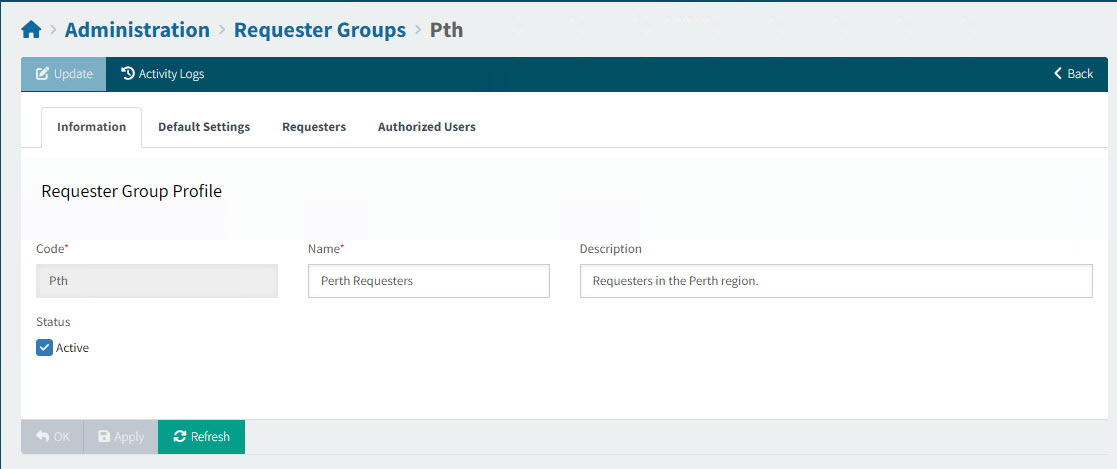
Open the Information tab.
View Information Tab
-
Optionally edit the Name.
-
Optionally edit the Description.
-
To de-activate the Requester Group, clear the Active check box. Select the check box to activate.
-
Select Apply to save changes, or OK to save changes and return to Requester Groups. To abandon your changes, select Refresh.
| You cannot delete a Requester Group if it is associated with an Approval Node in an Approval Tree. |
Assigning Default Settings to a Requester Group
These are the defaults for Requesters from this Requester Group when a User creates a new document on their behalf, such as a new Requisition.
| Note that the Default Settings for an individual Requester, if available, take precedence over these settings. |
To update the Default Settings for a Requester Group:
-
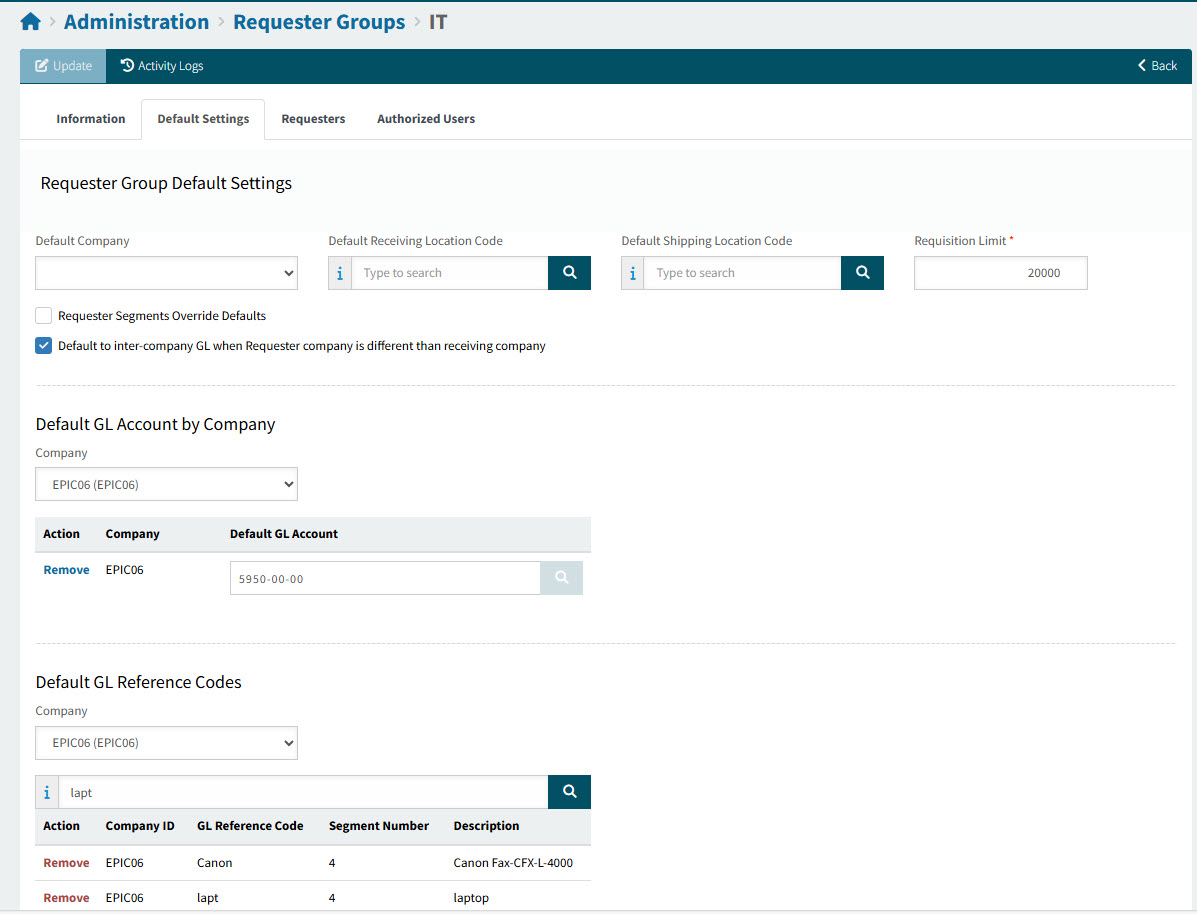
Open the Default Settings tab.
View Default Settings Tab
-
Optionally enter or select values in the Default Settings fields.
-
Select a Default Company from the drop-down list.
-
Search for and select a Default Receiving Location Code.
-
Search for and select a Default Shipping Location Code.
-
Enter a Requisition Limit.
Amounts below the Requisition Limit are auto-approved. (Note that the approval tree’s configuration must have Enable User Limit selected.)
If the Requisition Limit is 0.00 (zero), there is no limit (all amounts will be under the Requisition Limit). -
Select Requester Segments Override Defaults to default the GL Account Code from the Default GL Account, instead of using the GL Account Mask Sequence setting to build a GL Account Code. If there is a Default GL Reference Code, then this is used as the default GL Reference.
-
Select or clear the Default to inter-company GL when Requester company is different than receiving company check box.
-
Selected: The system will default to inter-company GL accounts when the Default Company is different from the receiving location’s company.
-
Cleared: The GL account defaults according to the standard logic for the receiving company, without applying inter-company logic.
-
-
Select Default GL Account by Company. This allows you to choose a default GL Account Code for one or more of the available companies.
-
Select a Company from the drop-down list.
-
Select a Default GL Account for the company.
-
-
Select Default GL Reference Codes from the search box.
-
Search for and select a Default Account Mask or enter a GL Mask, i.e. a partial GL Account code.
-
-
Select Apply to save changes, or OK to save changes and return to Requester Groups. To abandon your changes, select Refresh.
Assigning Requesters to a Requester Group
Assign Requesters to a Requester Group to enable the Requester Group’s authorized Users to raise a Requisition on their behalf.
Requesters inherit the Requester Group Default Settings when they don’t have their own Requester Default Settings. For example, if a Requester has no Default Receiving Location, their Requester Group’s Default Receiving Location is used instead.
To assign Requesters to the Requester Group:
-
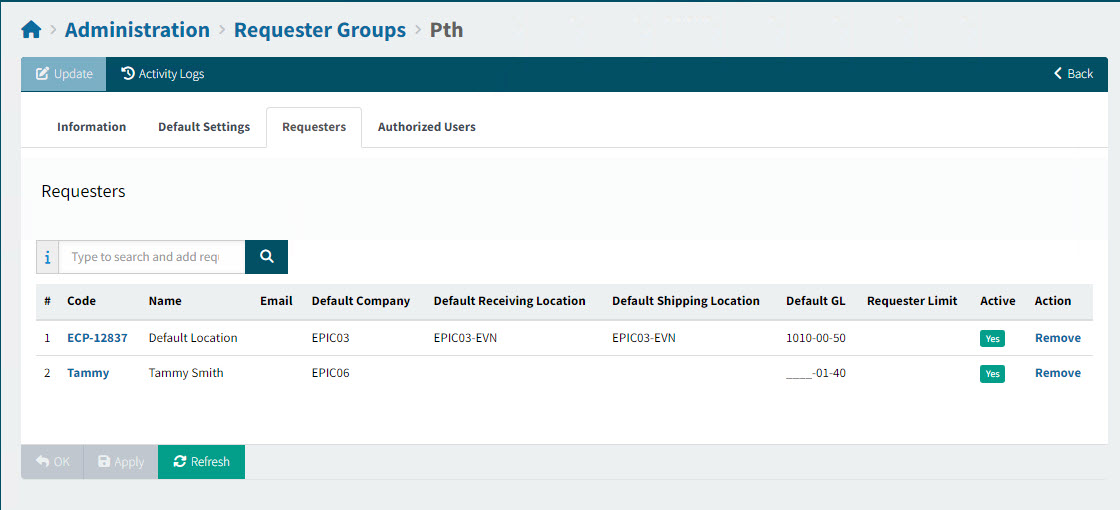
Open the Requesters tab.
View Requesters Tab
-
Search for a Requester in the search box, then select to add to the list of Requesters. You can click Remove under the Actions column, to remove a Requester from the list.
-
Select Apply to save changes, or OK to save changes and return to Requester Groups. To abandon your changes, select Refresh.
Removing Requesters from a Requester Group
To remove a Requester from a Requester Group:
-
Open the Requesters tab.
-
Click the Remove button under the Actions column, for the row containing the Requester to remove.
-
Select Apply to save changes, or OK to save changes and return to Requester Groups. To abandon your changes, select Refresh.
Assigning Authorized Users to a Requester Group
Authorized Users of a Requester Group may raise Requisitions on behalf of any Requester belonging to the Requester Group.
Authorized Users may belong to several Requester Groups, and can therefore raise Requisitions for Requesters from any of those Requester Groups.
To assign an Authorized User to a Requester Group:
-
Open the Requester Group.
-
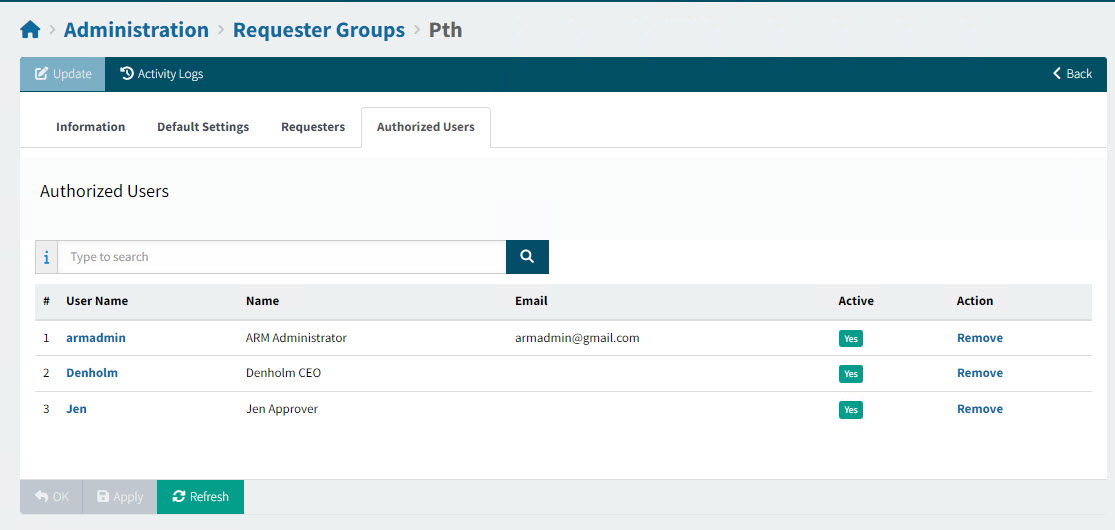
Open the Authorized Users tab.
View Authorized Users Tab
-
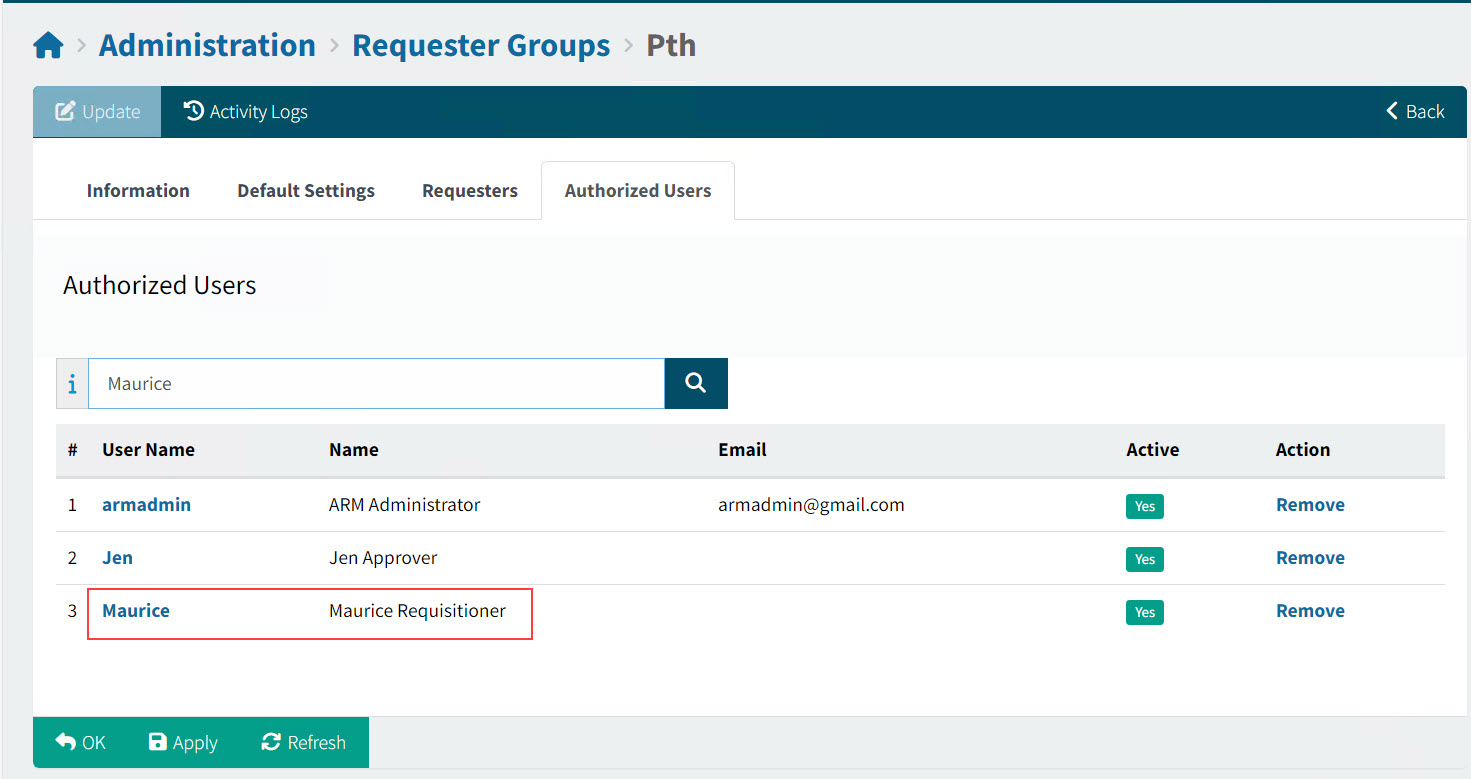
Search for and select a User from the search box.
The User is added to the list of Authorized Users for that Requester Group.
-
Click Apply to save the changes.
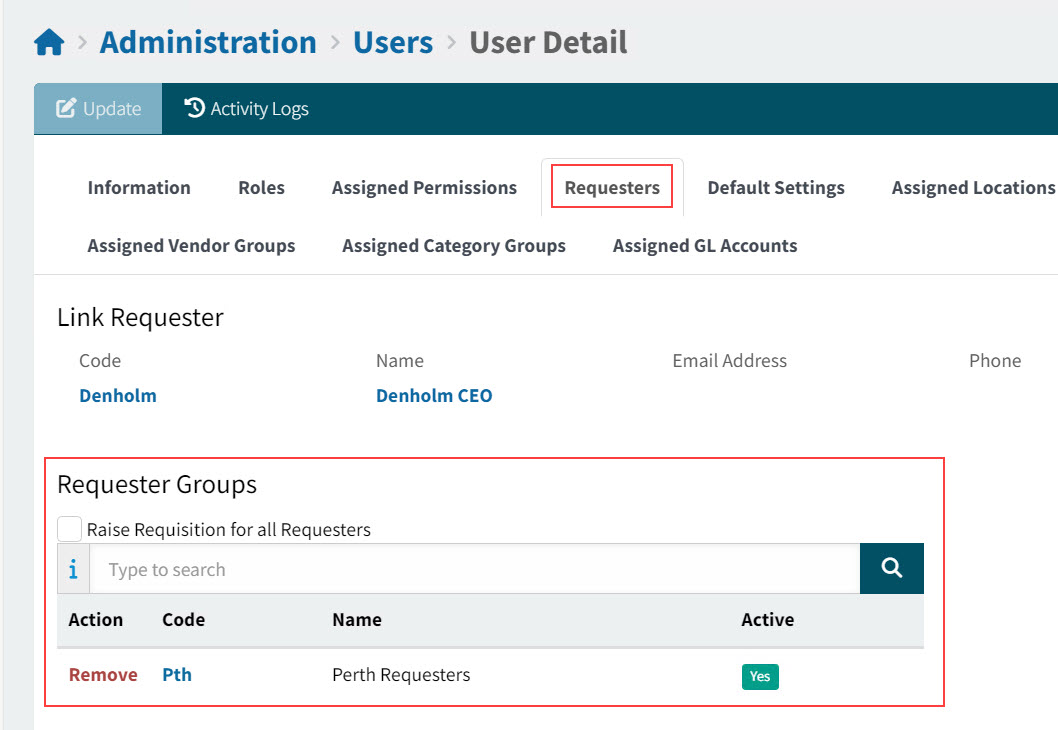
On the User Detail page for the Authorized User, the Requester Group is listed under the User’s Requester Groups list.
-
You can click on the User Name column to open the Administration > Users > User Detail page for the User.
View Details
-
Continue to add Authorized Users to the Requester Group.
-
Select Apply to save changes, or OK to save changes and return to Requester Groups. To abandon your changes, select Refresh.
| See how to add Requester Groups to a User from the User Detail page: Requesters on the User Detail page. |
Removing Authorized Users from a Requester Group
To remove an Authorized User from a Requester Group:
-
Open the Authorized Users tab.
-
Click the Remove button under the Actions column, for the row containing the Authorized User to remove.
-
Select Apply to save changes, or OK to save changes and return to Requester Groups. To abandon your changes, select Refresh.
Deleting a Requester Group
To delete a Requester Group, you first need to remove all Requesters and Authorized Users from that group.
-
Select a Code or Name to open the Administration > Requester Groups > [Requester Group Code] page.
-
Click on the Requesters tab and remove all Requesters. Save the changes.
-
Click on the Authorized Users tab and remove all Authorized Users. Save the changes.
-
Click Delete on the Footer Menu.
-
Click Yes on the Confirmation Dialog.
The Requester Group is deleted.
Exporting a Requester Group
Use this function to export a list of requester groups. This can be used as follows:
-
As a template for performing bulk updates on selected requester groups.
-
As a file of requester group updates to import in a different environment.
To create a file of requester groups:
-
Filter a list of requester groups to update, using the filter conditions.
-
Click the
 Export button on the Menu Bar.
This creates a CSV file of the filtered requester groups, called 'RequesterGroups_[YYYY-MM-DD]'.
The file contains instructions, as well as details for the list of selected requester groups.
Importing a Requester Group
Use this process to bulk update a batch of requester groups.
-
Export a selection of requester groups to a file.
-
Update the contents of the file.
-
Click the
 Import button on the Menu Bar.
 -
Click Choose File, then browse to and select the file to import, and click Open.
-
Click Import.
-
Wait until the progress bar under the Upload Progress shows 100% Completed.
After importing:
To update the details for any one requester group, select that requester group from the Administration > Requester Groups page. See Editing a Requester Group.